
Pattern or Coincidence
Is Peter Thiel buying drone companies, or buying future data exhaust from allied defense systems?

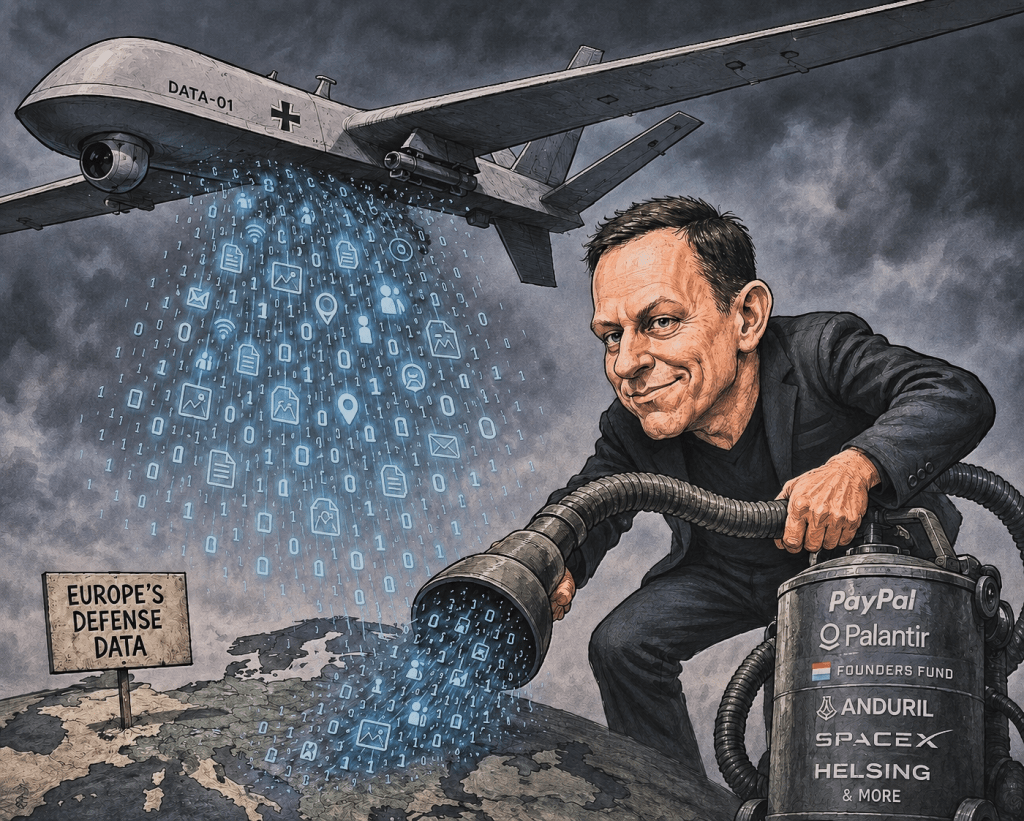
The recent drone controversy in Germany did not begin as an abstract technology debate. It began with a concrete procurement question: should Germany move forward with drone contracts involving startups such as Helsing and Stark Defense, while one of Stark Defense’s early and controversial investors is Peter Thiel? The public argument quickly moved toward politics, ideology, and influence, and this is understandable. Thiel is not a neutral figure in European privacy debates, and Palantir’s police and government footprint already carries weight in Germany. [1]
But this paper takes up a narrower question. Not whether one investor is personally unacceptable, not whether Germany should or should not buy a specific drone system. The deeper question is what strategic value accumulates around the data ecosystems that modern defense systems generate over time. Who ultimately owns, routes, benefits from, and accumulates the informational residue of modern warfare systems?
Recent German drone discussion in the news cycle did not emerge from nowhere. European officials have spent years describing sovereignty in increasingly technological terms: data infrastructure, networks, communications, supplier diversity, dependency reduction, and defense capability itself. That does not prove any investor or company is seeking improper influence. It does something more useful: it shows Europe already knows the terrain. Europe is not unaware of the sovereignty problem, it has named it repeatedly. The deeper question is whether urgent defense procurement can move fast enough without rebuilding the same dependencies Europe says it wants to escape. [2]
That need for rapid defense procurement is where Peter Thiel enters the analysis. Not as the whole story, nor as proof of anything by himself. He is the pressure point where AI, defense, capital, data, infrastructure, sovereignty, and dependency all collide at once. The uncomfortable question is not whether Peter Thiel is a good investor, he clearly is. It is whether his investment pattern repeatedly places him near systems where data becomes power. Peter Thiel’s own public writing gives critics an easy entry point to ask the first questions. In a 2009 Cato essay, he wrote, “I no longer believe that freedom and democracy are compatible.” [3] That quote should not be used as proof of a hidden plan, it is ideological context and not evidence of misconduct. But when a figure associated with that view is also associated with companies operating near intelligence, policing, military, healthcare, and defense infrastructure, democratic states are justified in asking harder questions about influence, access, and dependency.
From Ideology to Infrastructure
The weakest version of this argument is “Thiel is bad.” That is too easy to dismiss, and it centers the wrong thing. The stronger version is colder: why do the Thiel-linked companies and investment circles keep appearing near institutional systems that centralize, structure, analyze, or operationalize large-scale data?
Palantir is not just a vendor of isolated software tools. Across defense, policing, healthcare, and government administration, its recurring role is to make fragmented institutional data usable, searchable, and operational. That is the company’s strength, and it’s also why the scope question matters. Palantir’s defense is that it makes data useful. The concern is that it makes too much data useful, across too many institutions, for too many state functions. The healthcare example is useful because it forces fairness. In the United Kingdom, NHS England awarded a Palantir-led consortium the Federated Data Platform contract, potentially supporting up to 240 NHS organizations over a maximum seven-year term. NHS England says the data remains under NHS control, that Palantir cannot commercialize NHS data, and that Palantir cannot use NHS data to train or derive new supplier products. Those safeguards matter and they should be stated plainly. [4]
These safeguards also reveal the scale of the system: a platform requiring formal governance, data protection impact assessments or DPIAs, role controls, local and national instances, breach procedures, and controller/processor definitions is not just an app. It is institutional data infrastructure, and the risk is not that no one is watching. The risk is that the system becomes too wide, too embedded, and too cross-domain to watch meaningfully. This same pattern appears in policing. Hesse’s Interior Ministry describes hessenDATA as a police analysis platform in use since 2017 and based on Palantir software. Bavaria later said Palantir was the only supplier meeting criteria for its VeRA police analysis system after a European-wide tender, while also saying that no competitive European alternative currently exists and that the long-term goal remained European-developed software. [5]
That is not conspiracy, it’s dependence by procurement necessity. When a state says it needs the capability now but still wants a European alternative later, it has already created the dependency problem itself. The issue is not whether Palantir makes data useful, it clearly does. The issue is whether democratic institutions can govern systems whose usefulness comes from making more data operational across more domains.
The Drone Is Not Only the Weapon
A modern drone is not just an aircraft carrying a sensor or warhead. In ISR doctrine, collection is tied to processing, exploitation, dissemination, targeting, and assessment. NATO describes intelligence, surveillance, and reconnaissance as foundational to military operations, and Joint ISR as the fusion of information from assets across space, air, land, and maritime domains. [6] That doctrinal framing matters. The value is not only the sensor. It is the fusion and use of what the sensor produces. NATO has described its RQ-4D remotely piloted aircraft as collecting ISR data sets used by all Allies. UK joint doctrine treats JISR as more than collection. It includes collection, processing, exploitation, dissemination, and results delivered to commanders and staffs. [7]
Technical standards reinforce the same point. Motion imagery is not merely video. It can include metadata such as geospatial references, platform location, sensor orientation, field of view, timing, target information, and, where captured or fused, environmental conditions such as weather. UAS metadata standards and NATO motion imagery standards exist so imagery and associated information can move through interoperable systems. [8] A drone sortie ends. The data pattern may not. Depending on the platform, payload, integration, and mission, drone systems can generate data far beyond the immediate live view on a screen. They may create or contribute to terrain mapping, elevation modeling, road and chokepoint identification, RF spectrum mapping, signal-density analysis, communications relay discovery, network topology indicators, response-time patterns, force-movement behavior, logistics routes, electronic warfare reaction signatures, air-defense activation timing, sensor-emission catalogs, and long-term operational metadata. Not every drone collects every category. A loitering munition is not automatically a strategic ISR aircraft. Vendors and investors do not automatically receive operational data. Those distinctions matter. But the basic point survives hostile scrutiny: modern drone systems are not isolated hardware. They are nodes in sensing, metadata, processing, dissemination, targeting, and decision-support ecosystems.
There is also a maintenance-access issue. In modern weapon systems, field support is often performed by vendors or vendor contractors. That can give contractors practical access to systems, diagnostics, logs, software states, and integration behavior that may exceed what policymakers imagine when they approve “hardware” procurement. Even without ownership of operational data, maintenance access can become a quiet knowledge channel. That changes the meaning of procurement. A state may buy the drone. But the longer-term strategic value may accumulate in the software, metadata standards, tasking systems, data links, processing tools, integration layers, and analytical models that turn drone activity into operational knowledge.
The aircraft returns to base. The metadata keeps working.
The Capital Gap Was Not a Money Gap
Europe’s defense-startup capital problem was never simply a shortage of money. It was a shortage of willing, fast, defense-risk capital. Western Europe had capital, but defense venture appetite was constrained by ESG criteria, European sustainable-finance rules, reputational risk, public-fund restrictions, prime-contractor dominance, slow procurement paths, and uncertain exits. [9] Reuters captured the old bottleneck clearly: European defense-tech venture capital had risen to $1 billion in 2024, up from $373 million in 2022, but still represented only 1.7 percent of European venture capital. Meanwhile, the European Defence Fund shows that public money did exist, with a budget of nearly €7.3 billion for 2021-2027. The problem was not money in the abstract. It was the form, speed, appetite, and permission structure of the money. [10] The money existed. The permission structure did not.
That picture is changing, Dealroom and the NATO Innovation Fund reported that European defense, security, and resilience startups raised a record $8.7 billion in 2025, up 55 percent year-over-year, with AI underpinning 44 percent of the funding. Europe did not suddenly find money. It found urgency. [11] But the timing matters. When American or foreign capital enters a strategic gap first, it does not always leave once Europe catches up. Crisis capital rarely leaves cleanly, it arrives as rescue money, then stays as architecture, dependency, access, and influence.
This does not require a perfect historical analogy. The point is simpler: crisis dependency often outlives the crisis. Britain received wartime rescue from the United States, then lived with postwar financial consequences for decades, including the Anglo-American loan and its long repayment tail. That does not make European defense startups equivalent to wartime national debt. It does suggest that strategic finance can create obligations and structures that last far longer than the emergency that justified them. [12]
Europe is now funding defense startups because it must. The question is who bought the early architecture while Europe was still deciding whether it should.
Sovereignty Is Not Just Where the Factory Sits
European leaders already understand that sovereignty is no longer only territorial. The European Commission has tied technological sovereignty to the integrity and resilience of data infrastructure, networks, and communications. EU defense documents now speak openly about technological sovereignty, supplier diversification, and dependency reduction. German and EU leaders have framed defense capability itself as a sovereignty issue. [13] That is why the drone question cannot be reduced to “Is the aircraft made in Europe?” Production matters, but production location is only part of the sovereignty problem. The software layer matters. The update path matters. The data-link architecture matters, the training environment matters, the integration layer matters, the analytics stack matters, the maintenance relationship matters, and the contractual data rights matter. A nation may own the drones and still not fully own the informational architecture surrounding them.
The next split may be between the airframe and the sovereign software load. One country may buy the same drone platform as another, but run different mission software, data rules, encryption, targeting logic, autonomy limits, and integration tools. In that model, sovereignty moves away from the factory floor and into the software loaded onto the platform. This is the dependency problem in miniature: use the foreign system now, hope sovereignty catches up later. Sometimes that may be the correct decision. A state facing a real threat may not have the luxury of waiting for perfect domestic alternatives. But the tradeoff should be named honestly. Operational convenience can become sovereignty erosion when the convenient system becomes the system everyone else has to build around. This is not formal coercion. It is structural pull. Once the mission is defined around certified platforms, procurement choices narrow. [14] This is not an anti-American argument. European strategic autonomy language often frames reduced dependence as compatible with a stronger Atlantic alliance.
The issue is not alliance versus sovereignty. The issue is whether allied dependency today becomes strategic leverage tomorrow.
Future Wars May Be Informational First
In civilian systems, trust is becoming infrastructure. The question is no longer only who speaks. It is who gets believed at scale. Search, social feeds, recommender systems, verification tools, review platforms, and AI-mediated discovery can shape which identities become visible and which ones disappear. The next strategic control layer is not simply who speaks. It is who gets believed at scale. [15] The military version is harsher: who gets sensed, classified, routed, targeted, trusted, and acted on at scale?
Future war may not begin with a strike. It may begin with control over perception, signals, identity, classification, targeting confidence, network visibility, and decision-routing inside command systems. In that sense, conflict may begin before either side recognizes it as war. A state may already be shaped, mapped, probed, classified, or strategically constrained before the first visible strike. The aggressor may call it preparation. The victim may not recognize it until the data layer has already been turned against them.
That is why data exhaust matters. It’s not only a privacy problem. It’s a strategic intelligence problem. Battlefield data can reveal not only where forces are, but how they move, react, communicate, resupply, decide, and which systems they trust. This is traditional OPSEC, but enlarged from individual behavior to whole-force pattern exposure. The future value may not be in the drone alone. It may lie in the accumulated pattern.
Fair Reading and Counterarguments
The counterarguments matter and they prevent this from becoming a suspicion essay dressed up as analysis.
First, this may be ordinary venture investing rather than strategic positioning. Thiel and Founders Fund often invest where markets are moving: defense tech, AI, autonomy, and infrastructure. The simpler explanation may be that drones are becoming valuable, Europe is finally buying them, and investors are following the money.
Second, investment does not equal operational control. A minority stake does not automatically create access to military data, product decisions, source code, customer systems, or procurement strategy. Without board control, contractual access, privileged technical rights, or data-sharing pathways, influence may be limited.
Third, European governments can impose safeguards, but only if they do so at the front end. Defense contracts can restrict data access, IP transfer, hosting, maintenance, telemetry, export control, foreign ownership influence, and operational integration. Once the system is fielded, integrated, updated, and trained into doctrine, renegotiating control becomes much harder. The real issue may not be the investor, but whether governments write and enforce strong contract terms before dependency forms.
Fourth, foreign capital may be necessary for speed. Europe’s own officials say defense capability and sovereignty matter, but urgency also matters. If European capital and procurement move too slowly, rejecting fast outside capital may weaken defense readiness more than it protects autonomy.
Fifth, data exhaust does not automatically flow to vendors or investors. Drones can generate valuable metadata, ISR products, and operational patterns, but those outputs may remain under military control. The danger is plausible, not proven. It must be examined through architecture, contracts, integration, custody rules, telemetry paths, and governance mechanisms.
Those counterarguments do not collapse the thesis. They sharpen it. The question is not whether every risk has already materialized. The question is whether Europe is building defense systems in a way that makes those risks governable before dependency hardens.
The Question That Remains
Maybe Peter Thiel is simply a brilliant investor making rational bets on emerging defense technology. That is entirely possible. But the pattern remains difficult to ignore. Again and again, his investments and associated companies appear near systems designed not merely to process information, but to centralize it, structure it, and operationalize it at scale.
At what point does recurring proximity to the world’s future data infrastructure stop looking accidental? And more importantly: who ultimately benefits from the informational residue left behind by modern systems of war, governance, and prediction?
Source Notes
[1] DW Berlin Briefing transcript supplied by author, Feb 2026, discussion of German drone procurement, Stark Defense, Helsing, Peter Thiel, Palantir, sovereignty, and German political concern.
[1a] Reuters: Germany planned strike-drone purchases from Helsing and Stark, with a larger framework agreement. https://www.reuters.com/business/aerospace-defense/germany-order-strike-drones-worth-536-million-euros-2026-02-10/ ; Reuters: Stark was valued at more than €1B after a funding round; Manager Magazin reported that Founders Fund contributed a double-digit million-euro amount. https://www.reuters.com/business/finance/germanys-stark-valued-more-than-1-billion-euros-funding-round-says-manager-2026-02-13/ ; Defense News: budget committee approved €268M each for Stark and Helsing, with options up to €1B each. https://www.defensenews.com/global/europe/2026/02/26/once-reluctant-germany-goes-big-on-one-way-attack-drones/
[2] European Commission, German Federal Government, European Council, and EU White Paper references on technological sovereignty, strategic autonomy, data infrastructure, networks, communications, defense capability, supplier diversity, and dependency reduction. https://commission.europa.eu/system/files/2020-02/communication-shaping-europes-digital-future-feb2020_en_4.pdf
https://defence-industry-space.ec.europa.eu/document/download/30b50d2c-49aa-4250-9ca6-27a0347cf009_en?filename=White+Paper.pdf
https://www.bundesregierung.de/breg-de/aktuelles/rede-von-bundeskanzler-merz-beim-world-economic-forum-am-22-januar-2026-in-davos-2403600
[3] Peter Thiel, “The Education of a Libertarian,” Cato Unbound, 2009. https://www.cato-unbound.org/2009/04/13/peter-thiel/education-libertarian
[4] NHS England Federated Data Platform contract explainer, https://www.england.nhs.uk/digitaltechnology/nhs-federated-data-platform/security-privacy/contract-explainer/; FDP FAQs, information governance framework, and overarching DPIA. https://www.england.nhs.uk/digitaltechnology/nhs-federated-data-platform/fdp-faqs/
[5] Hesse hessenDATA official material, Bavarian VeRA statements, and German Federal Constitutional Court automated police data analysis decision. https://innen.hessen.de/presse/pressearchiv/polizei-analyseplattform-zum-schutz-vor-terroristen-und-schwerstkriminellen
https://www.stmi.bayern.de/news/detail/herrmann%3A-vera-ist-sinnvoll-und-notwendig/
https://www.bundesverfassungsgericht.de/SharedDocs/Entscheidungen/EN/2023/02/rs20230216_1bvr154719en.html
[6] NATO Joint Intelligence, Surveillance and Reconnaissance material. https://www.nato.int/en/what-we-do/deterrence-and-defence/joint-intelligence-surveillance-and-reconnaissance
[7] Drone metadata and ISR doctrine: https://shape.nato.int/news-archive/2023/nato-drone-unit-has-provided-hundreds-of-flying-hours-collecting-critical-intelligence-for-the-alliance ; NATO RQ-4D/NISRF material and UK Joint Doctrine Note 1/23 on JISR. https://assets.publishing.service.gov.uk/media/641c27e15155a200136ad4df/JDN_1_23_ISR_web.pdf
[8] STANAG 4609, MISB motion imagery metadata material, and UAS metadata standards. https://gwg.nga.mil/gwg/focus-groups/Motion_Imagery_Standards_Board_%28MISB%29.html
https://www.iosb.fraunhofer.de/en/projects-and-products/stanag-4609-validator.html
[9] Reuters reporting on European defense-tech venture funding, ESG restrictions, public-fund limits, primes, and procurement barriers. https://www.reuters.com/business/finance/how-vcs-are-navigating-europes-defence-spending-push-2025-06-16/
[10] European Defence Fund official page and Reuters funding statistics. https://defence-industry-space.ec.europa.eu/eu-defence-industry/european-defence-fund-edf-official-webpage-european-commission_en
https://www.reuters.com/business/finance/how-vcs-are-navigating-europes-defence-spending-push-2025-06-16/
[11] NATO Innovation Fund / Dealroom report on European defense, security, and resilience startup funding in 2025. https://www.nif.fund/news/dealroom-and-nato-innovation-fund-european-defence-security-resilience-startups-smash-record-with-8-7b-raised-in-2025/
[12] UK Government History of Government blog, Anglo-American Financial Agreement context and postwar loan repayment history. https://history.blog.gov.uk/2020/12/07/whats-the-context-signing-the-anglo-american-financial-agreement-6-december-1945/
[13] European Commission, “Shaping Europe’s Digital Future,” https://commission.europa.eu/system/files/2020-02/communication-shaping-europes-digital-future-feb2020_en_4.pdf ; European Commission, “White Paper for European Defence,” https://defence-industry-space.ec.europa.eu/document/download/30b50d2c-49aa-4250-9ca6-27a0347cf009_en?filename=White+Paper.pdf
[14] The F-35A was certified to carry the B61-12 in 2024, and several NATO nuclear-sharing states are moving toward or using F-35A platforms. https://breakingdefense.com/2024/03/exclusive-f-35a-officially-certified-to-carry-nuclear-bomb/
[15] Civilian version of this argument in “When Trust Becomes Infrastructure,” where I argued that the next control layer is not who speaks, but who gets believed at scale. https://btne.net/trust-becomes-infrastructure/