
When Trust Becomes Infrastructure
Authenticity, identity, word of mouth, and the platform control layer

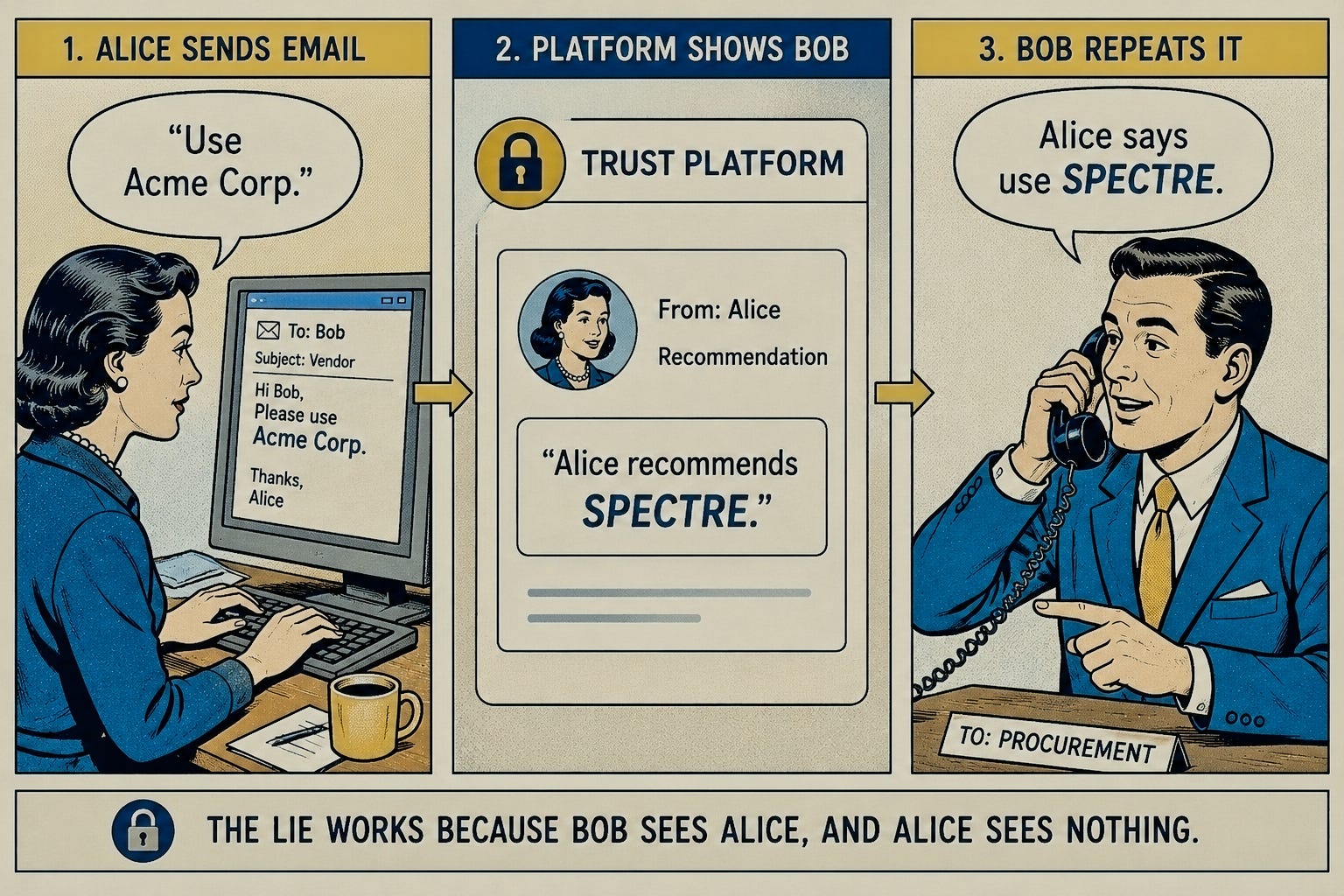
A simple example of routed trust
This started as a simple question in my head about word of mouth. Then it turned into a bigger one: what happens when platforms decide which trusted voices get seen, copied, licensed, or buried?
We used to treat trust as a human relationship, then digital platforms turned it into a measurable signal. Now AI and algorithmic systems are turning it into routed infrastructure – trust still feels human, but its reach is now controlled by platforms.
The next strategic control layer is not simply who speaks. It is who gets believed at scale. I argued this last year in two earlier pieces: Control or Relevance and Show Me the Money. Control or Relevance framed the visibility problem: if discovery becomes AI-mediated, opting out can mean becoming invisible. Show Me the Money framed the economics problem: creators may need licensing, attribution, derivative rights, and premium human authenticity to survive. This paper moves that argument forward. The issue is not only relevance or money. Trust itself is now being routed. [9][10]
We used to think word of mouth was human. A neighbor recommended a contractor. A friend recommended a candidate. A musician spread in popularity because people told other people. A name, a voice, or a face carried weight because the listener had some sense of the person behind it – think Orson Welles, David Attenborough or Luciano Pavarotti. That world still exists, but it is no longer the whole system.
Today the mouth can be rented, spoofed, licensed, cloned, verified, ranked, or buried. A fake local business can manufacture the appearance of neighborhood trust. A paid influencer can present paid political sponsorship as personal enthusiasm. A platform can decide whether a real artist reaches her own audience. A synthetic voice can sound trusted. This changes the meaning of authenticity, and it also changes the meaning of trust: authenticity is becoming the product, trust is becoming the distribution system, and identity is becoming the infrastructure underneath both.
Word of mouth worked because people did not need perfect information to trust a recommendation. They had some sense of who was speaking, what that person knew, what shaped their judgment, and whether they had anything to lose by being wrong. It was imperfect. People exaggerated, friends made bad recommendations, and local reputations could still be manipulated, but the system made sense because trust moved through social contact, repeated exposure, personal credibility, and accountability. In that older model, awareness spread the signal. Trust carried the signal. Identity anchored the signal.
Platforms don’t just show us what people say. They decide what gets put in front of us. That means awareness is not just about someone speaking; it’s also about whether the system lets the right people see it.
Search results, social feeds, recommendation engines, creator marketplaces, review platforms, ad systems, and verification tools all sit between the speaker and the listener. They decide which posts, reviews, videos, candidates, artists, contractors, and brands enter the awareness stream. Awareness is no longer just about communication. It’s about allocation, and that’s the key turn. AI does not just amplify word of mouth, it can allocate whose word of mouth becomes visible. Discovery, ranking, recommendation, and suppression decide which identities gain momentum, and that lets platforms shape trust before people even see it.
Consider our friends Bob and Alice. Bob trusts Alice’s judgment on contractors, restaurants, tools, or local services. In a normal review system, Bob must know that Alice actually wrote the review, Alice must be able to see what is being attributed to her, and the platform must not silently alter, suppress, or target the review.
AI makes that darker. If the system knows Bob trusts Alice, it could fabricate a review from Alice, show it only to Bob, and hide it from Alice. Bob would see the name he trusts. Alice would never see the lie. The deception would not be a fake review broadcast to everyone. It would be a custom trust lie aimed at the person most likely to believe it. That is not just a fake review. It is a lie routed through trust.
The cleanest non-AI example is local services. In May 2026, the Federal Trade Commission and Illinois sued Premium Home Service and its owner, alleging that the company created thousands of fake online business listings for local home repair businesses. The FTC says the profiles used fabricated business names, false or unrelated local addresses, and fabricated five-star reviews that helped dilute legitimate one-star reviews. The complaint also says consumers searching for local services across the United States were diverted to these business profiles through common repair keywords. [1] This is identity as infrastructure before AI fully enters the scene. The consumer thinks he is seeing local reputation. In reality, he may be seeing a manufactured identity routed through search. The business name, local address, search ranking, star rating, and review stream all act like trust signals.
The lesson is not merely that fake reviews are bad. The sharper lesson is that identity can be assembled from signals. Once those signals are assembled, search can route trust toward the assembled identity.
A second current example is political influencer marketing. In May 2026, The Washington Post reported that Tom Steyer’s California gubernatorial campaign was under investigation over payments to influencers, some of whom allegedly failed to disclose the payouts. The report described thousands of dollars in payments to creators, a state investigation into possible ad-disclaimer violations, and complaints that the campaign could create the appearance of grassroots enthusiasm. The Steyer campaign said it compensates creators for time and work product, discloses payments in campaign finance reports, and informs directly hired creators about disclosure requirements. [2] This is bought word of mouth. The content does not work like a normal ad because it borrows the influencer’s identity. The audience is not only receiving a political message. It is receiving the message through someone it may already trust. That matters because hidden payment changes the trust chain. The issue is not only whether money changed hands. The issue is whether paid persuasion is routed through identities that look organic to the audience.
This is why authenticity is becoming a product. The campaign is not merely buying reach, it’s buying access to pre-existing credibility.
The third example is platform visibility. TikTok’s 2026 marketer forecast describes tools that unify paid and organic data to show how people discover, talk about, and buy from brands, connecting awareness to conversion in real time. [3] That is useful for marketers, but it also reveals the deeper system: discovery, attention, conversation, and conversion are tracked and steered. The artist side shows the cost. In May 2026, MusicRadar reported Lizzo’s criticism that algorithm-based social media can prevent audiences from seeing release information. Her complaint was not that people dislike the music. It was that chronological reach has weakened and even fans may not know something has been released. [4] This is the clean bridge to the larger argument. Real identity and real audience trust do not guarantee visibility. A musician can have fans, a creator can have followers, a business can have satisfied customers, and a writer can have a sharp idea. None of that guarantees awareness if the routing layer does not surface the signal. The platform that controls visibility controls which word of mouth becomes growth and which word of mouth becomes nothing.
The non-AI examples show the old trust system breaking. AI voice and likeness licensing show the next formal layer being built around that breakage.
RSL Media launched the Human Consent Standard in May 2026 as a framework for AI use of creative work, name, image, likeness, identity, characters, and marks. Its announcement says the registry will allow people to declare AI permissions and turn consent into a machine-readable signal. [5] The Verge reported the same month that the Human Consent Standard will let people set terms for how AI systems use their likenesses and creative works. The report notes that the standard applies to the underlying work, identity, character, or mark itself, wherever it appears, and that a registry will translate those permissions into machine-readable signals. [6] That is almost the literal version of identity becoming infrastructure. The commercial version is moving the same way: voice becomes an asset, likeness becomes permissioned use, and identity becomes something that can be verified, licensed, routed, monetized, and defended. ElevenLabs’ Iconic Marketplace points in that direction, with the company describing a marketplace where creators can license AI voices and IP from well-known figures through rights holders, and The Verge reporting that ElevenLabs acts as the intermediary that formalizes licensing and synthesizes the voices. [7]
The fight is not only over misinformation. Misinformation is part of it, but that framing is too narrow. It focuses on whether a statement is true or false. The deeper power question is who gets trusted, who gets routed, and who gets believed at scale.
That creates a new set of infrastructure questions:
Who gets surfaced?
Who gets verified?
Who gets licensed?
Who gets copied?
Who gets buried?
Who can pay to borrow trust?
Who can prove that a voice, face, review, or recommendation is real?
These aren’t only speech questions; they’re control-layer questions. A platform that controls discovery can decide which real voices remain invisible and the marketplace that controls likeness licensing can decide which identities become usable at scale. A verification system can decide what counts as real enough and a ranking system can turn one person’s word of mouth into growth while another person’s disappears.
Counterarguments
Word of mouth is still human: Correct, the human layer still matters. People still trust friends, family, experts, customers, creators, and local reputations. That’s why the routing layer is valuable. It doesn’t replace human trust. It decides whether human trust scales.
Algorithms are just neutral recommendation tools: Even a neutral routing system still allocates opportunity, attention, and credibility. Neutrality doesn’t remove power from the system, it only changes the stated reason for the allocation.
Licensing identity could protect people: Yes. Consent standards, likeness detection, and licensing systems may protect people from theft, fraud, and impersonation. YouTube’s 2026 expansion of likeness detection to adult users is one example of identity defense becoming a platform feature. [8] But protection and control often arrive together. The same machinery that verifies, licenses, and protects identity can also become the gatekeeper for whose identity can travel, monetize, and scale.
Trust used to move person to person. Now it moves through platforms that can measure it, package it, rank it, sell it, suppress it, license it, or protect it. That’s why identity is becoming infrastructure. The next power layer isn’t who speaks, it’s who gets believed at scale.
Source notes
[1] Federal Trade Commission, “FTC and Illinois Take Action to Stop Deceptive Conduct by Company that Created Thousands of Business Listings of Fake Local Home Repair Businesses,” May 11, 2026. https://www.ftc.gov/news-events/news/press-releases/2026/05/ftc-illinois-take-action-stop-deceptive-conduct-company-created-thousands-business-listings-fake
[2] Drew Harwell, “California gubernatorial candidate under investigation over payments to influencers,” The Washington Post, May 15, 2026. https://www.washingtonpost.com/technology/2026/05/15/tom-steyers-influencer-campaign-triggers-california-investigation-over-undisclosed-posts/
[3] TikTok Newsroom, “Introducing TikTok Next 2026: Our Trend Forecast for Marketers for the Year Ahead,” January 13, 2026. https://newsroom.tiktok.com/introducing-tiktok-next-2026-our-trend-forecast-for-marketers-for-the-year-ahead
[4] Ben Rogerson, “The algorithm-based way that social media functions now is destroying the music industry,” MusicRadar, May 15, 2026. https://www.musicradar.com/artists/singers-songwriters/the-algorithm-based-way-that-social-media-functions-now-is-destroying-the-music-industry-lizzo-claims-its-the-reason-you-dont-know-about-her-new-album
[5] RSL Media, “RSL Media Launches, Centering Human Consent in the AI Era,” GlobeNewswire, May 12, 2026. https://www.globenewswire.com/news-release/2026/05/12/3293226/0/en/rsl-media-launches-centering-human-consent-in-the-ai-era.html
[6] Emma Roth, “George Clooney, Tom Hanks, and Meryl Streep back new Human Consent Standard for AI licensing,” The Verge, May 12, 2026. https://www.theverge.com/ai-artificial-intelligence/928534/rsl-media-human-consent-standard
[7] Jess Weatherbed, “ElevenLabs’ new AI marketplace lets brands use famous voices for ads,” The Verge, November 11, 2025. https://www.theverge.com/news/818470/elevenlabs-iconic-voice-marketplace-ai-audio
[8] Mia Sato, “YouTube is expanding its AI deepfake detection tool to all adult users,” The Verge, May 15, 2026. https://www.theverge.com/news/931884/youtube-likeness-detection-ai-deepfake-expansion-all-adults
[9] Anton Kaska, “Control of Relevance: Why Opting Out of AI Makes You Invisible,” Borealis Traders of New England, 2025. https://borealis-traders.com/control-or-relevance/
[10] Anton Kaska, “Show Me the Money: Surviving (and Thriving) in the AI Economy,” Borealis Traders of New England, 2025. https://borealis-traders.com/show-me-the-money/